
- Sound is a longitudinal wave, a spring rather than a string.
- Speed = frequency x wavelength (V = f x ₥)
- Didgeridoo is a closed pipe with the mouth blocking one end. Sound waves bounce off the closed and open ends and meet in opposite directions, interfere and set up a standing wave pattern or resonance.
- There are 3 frequencies involved in creating a didge sound namely:
- Spring/elastic frequency of the lips
- Resonant frequency of tube/pipe
- Sounding frequency
RESONANCE OF STRAIGHT DIDGE WITH A CONSTANT DIAMETER
Fundamental
f1 = V / 4L

Second resonance
f2 = 3f1

Third resonance
f3 = 5f1

Resonance of pipes are f1 3f1 5f1 7f1
The drone is generated when lip frequency is about 70Hz
L = 1.22m -> f1 = 70Hz (C#)
Standing waves in a flared didge are more complicated
Straight f1 3f1 5f1 7f1

Conical f1 2f1 4f1 6f1
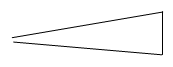
Greater the flare, greater the pitch and also toot
DRONE: A55 = 1.55m A110 = 0.77m
TOOT 1 = A220 TOOT 2 = A440
- Lips slap shut and stick for 0,5 of a cycle.
- Vocal tract acts as an adjustable filter to push out certain harmonies
- Vocal folds set up vibrations containing many harmonies
- PARASAUROLOPHUS was a large plant eating and didge playing dinosaur that lived 350 million years ago. In 1995 a perfect specimen was found in Mexico. The specimen was CAT scanned and the sound recreated based on the physics of its large horn comprising a large crest extending from its forehead.
- Some different names given to the didgeridoo (Western names) are: Yidaki, Ganbi, Giraki, Ganbag, Abar, Yiki-Yiki, Kanbi and Giraga.
- Trevor Jones (1967) is of the opinion that in terms of musical complexity, the yidaki is unique. He states, “In short it is a remarkable triumph of mind over matter for without any mechanical improvements over its relations in other parts of the world, the yidaki has developed a musical usefulness, variety and expressions not even hinted at elsewhere.”
- Lloyd Hollenberg has done work on low frequency harmonic generation in the didgeridoo. He used MRI and needed about 13 slices to obtain 3D images of the mouth changes during playing. In his research he was the only subject and used a small plastic pipe. He found the lower the note, the larger the mouth cavity and the lower the tongue. The higher the note, the smaller the mouth cavity and the higher the tongue.
- David Lindner in Germany is writing a book on the didgeridoo with contributions by people like Charlie McMahon.
- According to Moyle the yidaki is at least 2000 years old.
- Neville Fletcher from the Australian Natural University (ANU) has retired but does much research on the didgeridoo.
- Joe Wolfe at the University of New South Wales in Sydney in the Physics Department has won a prize with his research on the flute – used different frequencies to get specific notes.
- The Didge: Heard, Heed, Had, Head.
- Ian Keen: Knowledge and secrecy.
- Nancy Williams: The Yolin and their land.
- Howard Murphy: Ancestral Connections.
- Articles by Fiona Magowan, Frances Tamisan and Peter Tenes.